 Raising
How to Boost Kids' Confidence, Even in a Shy Child
Wondering how to boost kids' confidence when your child is shy? Start here: a shy child isn't a confident child with something missing. Shyness is a temperament, and confidence is something else entirely — the memory of having done hard things — which shy children can have in abundance if they're allowed to get it at their own pace.

Is shyness something I need to fix?
No. Shyness is largely a matter of temperament: some children are wired to watch first and join later, and that shows up early and often stays. It isn't a parenting failure, and it isn't a problem in itself.
What can become a problem is what a child concludes from it. If they're told, repeatedly, that they should be braver or more outgoing, they learn that the way they are is wrong. That lesson can do more harm than the shyness itself.
The realistic goal isn't a louder child. It's a child who can still do the things that matter to them while feeling shy — which is a very different project, and a much more achievable one.
What's the difference between shyness and low confidence?
Shyness is how a child feels when faced with new people or situations. Confidence is what they believe they can do.
They're easy to confuse because they look similar at a birthday party: both children are standing at the edge. But the shy child with confidence will join in eventually, once they've figured out how things go. The child without it may stand there all afternoon because they don't expect to manage.
Many shy children are quietly confident at home, in their own projects, with one close friend. That's worth noticing. It tells you the confidence exists and just needs a route into new situations.
How to boost kids' confidence when they're shy
Through small steps they actually finish, not through encouragement.
Confidence at this age is built from evidence. Each time a child does something that felt a bit too hard, and it turns out fine, they have one more piece of proof. Praise can't substitute for that, because it's your opinion, and children can often tell the difference.
So break the hard thing into steps small enough to complete. Ordering at a coffee shop might start with pointing at the pastry while you speak, then saying one word, then saying the whole order with you standing close. Let them choose the size of each step, and let them stop after it.
One finished small step beats one abandoned big one, every time.
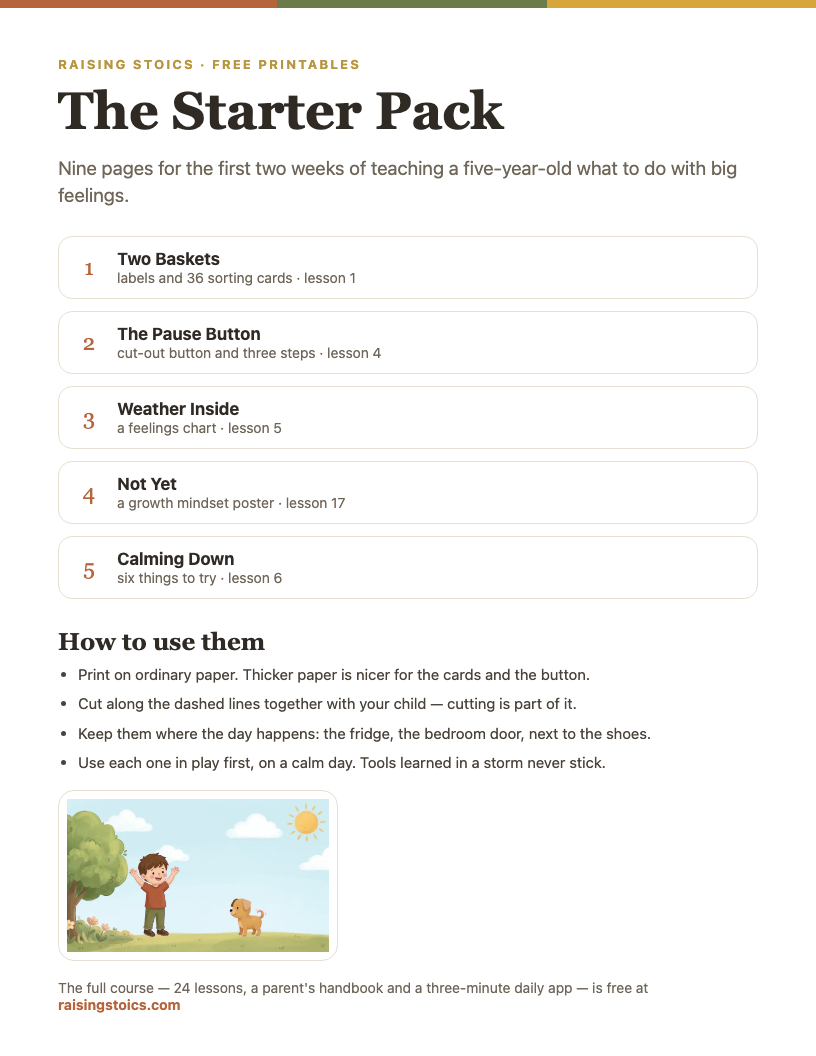
The Big Feelings Starter Pack
Nine pages for the first two weeks: a sorting game, a pause button, a feelings chart and a calm-down poster.
Download the free PDF See all 9 pages
Part of a free 9-page starter pack. Sign in with a code from your email — no password.
What builds confidence in 4- to 7-year-olds more than praise?
Doing real things, finishing them, and noticing that they finished.
Confidence at this age is mostly a memory: "I did a hard thing before, so I can probably do this one." Praise can point at that memory, but it can't create it. What creates it is experience.
Give them real jobs. Pouring their own drink from a small pitcher, carrying the grocery bag with the bread in it, buttering their toast, choosing the route to the park. Real jobs carry a message that pretend ones don't: you're trusted.
Let them finish. A puzzle completed over three days, a tower rebuilt after it fell, a drawing they kept going with. Finishing is where the memory gets written. It's tempting to step in and help at the hard part — that's exactly the part they need to do themselves, with you nearby.
Give choices. "Which shoes?" "Which book first?" Small decisions that stick build the sense that what they choose matters.
Then, afterward, help them notice: "Remember when you couldn't do the zipper? Now you do it every morning." You're not praising; you're helping them read their own history.
How do I prepare a shy child for a new situation?
Shy children do best when the new thing is a little less new by the time it arrives.
Preview it. Look at photos of the new school or the party venue, walk past the building on a weekend, read a book about a first day. Talk through what will happen, in order: "First we'll hang up your coat, then you'll meet your teacher, then you'll get to play."
Rehearse the hard part. If saying hello is hard, practice with toys, then with you, then with a grandparent. If joining a game is hard, practice the words: "Can I play too?"
Arrive early. Walking into a quiet room that slowly fills is much easier than walking into a crowd that's already loud and busy.
Give them a role. Handing out the napkins at a party, carrying the present, being in charge of the snack bag. A job gives a shy child a reason to be there and something to do with their hands.
And plan the exit. Knowing they can come and find you, or that you'll leave at a set time, makes it much easier to stay.
Should I make my shy child say hello?
No, and it's worth being gentle with the adults who expect it.
Forcing a greeting while a child is frozen can make the next greeting harder, because the moment may become one where they felt watched and failed. What helps is offering a smaller version: a wave, a nod, standing next to you while you say hello for both of you. Agree on these beforehand, at home, so they have a plan.
Try not to answer for them the second there's a pause, though. Give them a few seconds of silence first. And avoid explaining "they're shy" in front of them. Something like "they like to watch for a while first" describes the same thing without handing them a label to live up to.
Does praise help build confidence in kids?
General praise, not much. Specific description, yes.
"You're so brave!" said to a child who was terrified tends to bounce off, because it doesn't match what they felt. Worse, it can suggest that brave means not being scared, which makes their fear evidence that they aren't brave.
What works better is naming what they did: "You were scared, and you still asked her." "You waited until you were ready, and then you went down the slide." That's accurate, so they believe it, and it describes an action they can choose again.
Say it quietly and once. A big public celebration of a shy child's courage is just another spotlight.
How do I build confidence in a sensitive child?
Mostly by reducing surprise, since surprise is often where sensitive children lose their footing.
Preview new situations. Talk through what the party will be like, look at photos of the new classroom, drive past the pool before the first swim lesson. Arrive early, before a room is full and loud, so they join a small group that grows rather than walking into a crowd.
Give them a role: handing out napkins, being in charge of the ball. A job is a reason to be there that isn't about being social.
And let them recover afterward. A sensitive child who managed a busy day may need a quiet hour, and that's the cost of the day, not a sign it went badly.
Are there books that help shy or fearful kids?
Jabari Jumps by Gaia Cornwall is the one to start with. Jabari wants to jump off the high diving board, and climbs up and back down again before he does it. His father doesn't push; he waits, and offers a trick for the nerves. The book treats backing off as part of being brave rather than the opposite of it, which is exactly the message a shy child needs.
Read it more than once. Children often need a few readings before they start pointing out the parts that feel familiar.
It's also worth reading it without any follow-up lesson. A shy child can usually spot a moral being aimed at them from a long way off.
What should I stop saying about a shy child?
A few habits, all well-meant, tend to make shyness stickier.
Introducing them as shy. "Sorry, she's shy" said in front of a child becomes part of how they see themselves, and gives them a script to hide behind. Try describing the moment instead: "She likes to watch for a while first."
Apologizing for them. If an adult says hello and your child hides, you don't need to apologize. "She'll say hi when she's ready" protects both of them without turning it into a problem.
Answering for them every time. It's kind to rescue a child who's frozen, but if you always answer, they never get to try. Wait a few seconds; give them a chance to nod or point, and only then help.
Comparing them with a bolder sibling or friend. "Why can't you just join in like your cousin?" adds shame to shyness, and shame makes children pull back further.
And praising only the big, brave moments. Notice the small ones too: "You looked at her when she said hello. That was a start." Small steps noticed are the ones that get repeated.
When is shyness something to talk to a pediatrician about?
Most shyness is simply temperament and needs time rather than intervention. A few patterns are worth raising.
If a child talks freely at home but doesn't speak at all at preschool or with other adults for more than a month or so, mention it. The same goes for fear that is intense enough to disrupt sleep, eating, or leaving the house, or that is getting steadily worse rather than slowly easing. Worth raising, too, if they seem distressed and alone much of the time rather than content to watch.
None of these mean something is wrong. They mean a professional opinion is useful, and it's better to ask early than to push harder at home.
FAQ
How do I build confidence in kids?
Give them real responsibilities, let them finish hard things themselves, and offer choices that stick. Praise what they did — "you kept trying the zipper" — rather than calling them clever or brave. Let them struggle a little before you help. Confidence at ages 4–7 comes mainly from the memory of having done hard things, so the job is to create plenty of those moments.
How do I help a shy child socialize?
Start small and familiar. One friend at home, for a short time, with a simple activity to do side by side, like play dough or building. Practice the words for joining in beforehand. At group events, arrive early and give them a job. Don't push them into the middle; let them watch first. Many shy children join in fully once they've had time to warm up.
Can a shy child become confident?
Yes. Shyness is a temperament and tends to stay with a person, but confidence is a separate thing that grows with experience. Many shy children become very capable, confident adults who are still a bit quiet in new groups. The goal isn't to turn a shy child into an outgoing one; it's to help them do the things they want to do, at their own pace.
Is shyness genetic?
Partly. Twin and long-term studies suggest temperament — including how cautious a child is with new people and places — is influenced by genes and shows up early in life. But environment matters a lot too: how adults respond, how much gentle practice a child gets, and whether shyness is treated as a flaw. A cautious temperament can lead to many different outcomes.
What Is a Growth Mindset? Growth Mindset for Kids, Explained
What is a growth mindset, and how do you teach it to a 4- to 7-year-old? Why praising kids for being smart backfires, and the sentences that work instead.
Read next →Courage and The Bravery Ladder are lessons 9 and 10 of the program.