 Raising
Feelings Books for Children: How to Read Them So They Work
Good feelings books for children do their work in the pictures and in the pauses. How you read them matters more than which one you pick, and a common mistake is explaining the lesson once the story is over.

What makes a good feelings book for a young child?
It shows a feeling from the inside, and it doesn't hurry to fix it.
The useful ones let a character be really angry, scared, or sad for a few pages. You see what the feeling looks like in a body and what the character does about it, and then it changes. That shape is what a child is learning from: this is what it looks like, and it doesn't last forever.
The weaker ones name the feeling on page one, solve it by page three with a tip, and end on advice. Children can often tell when a story has turned into instructions, and many stop listening at about that point.
A quick test in the store: flip to the last page. If it's a list of calming tips, the book probably isn't a story.
How should I read a feelings book so it actually works?
Slowly, with stops, and without a moral at the end.
Pause on the pictures, not just the words. A lot of these books carry the feeling in the illustration: Sophie's red outline, the Color Monster's scribbled tangle. Let your child look for a while before you turn the page.
Ask one or two questions per reading, not ten. A reading that turns into a quiz stops being a story.
Skip the summary. "So you see, when we're angry we should..." undoes the work the book just did. The story already made its point, and the explanation just tells your child they were being taught something.
Then read it again, many times. After a few readings, many children start saying the character's feelings before you get to them.
What questions should I ask while reading?
Questions about the body and questions about the character. Questions about your child's own behavior can wait for another day.
Good ones: "What do you think she's feeling right now?" "How can you tell?" "Where in his body do you think he feels it?" "Is it getting bigger or smaller?" "What would you do if you were him?"
The one to avoid in the moment is the direct link: "That's like you yesterday, isn't it?" It turns the book into a way of talking about the meltdown, and a child who spots that may start refusing the book. If they make the link themselves, and they often do, just agree and keep reading.
And if the answer seems wrong, ask what they saw. "He looks happy" about a crying bear is interesting, not a mistake to correct.
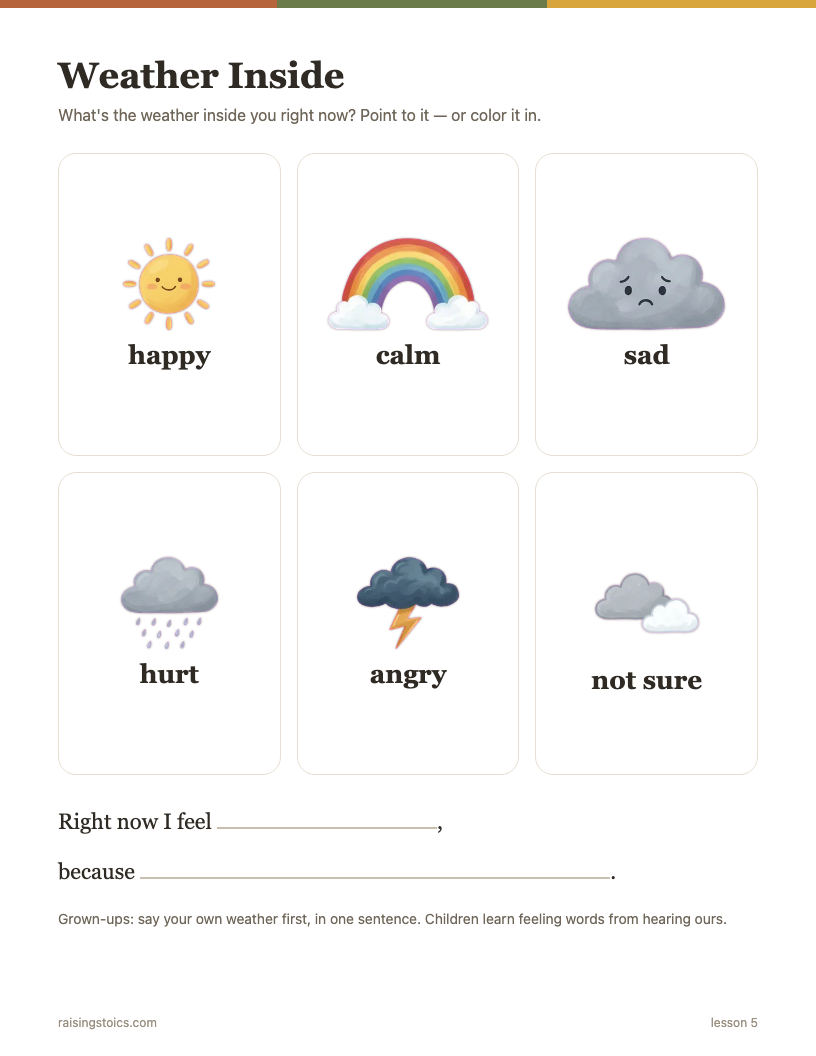
Weather Inside feelings chart
Six kinds of weather to point to, plus a “Right now I feel… because…” line.
Download the free PDF See all 9 pages
Part of a free 9-page starter pack. Sign in with a code from your email — no password.
Which feelings books help children name what they feel?
Two are especially good for building vocabulary.
The Color Monster by Anna Llenas. The monster wakes up with all his feelings tangled together, and a girl helps him sort them into jars, one color each. Sorting is something a 5-year-old already knows how to do, which is why the book may land better than a chart. Afterward, ask which jar today's feeling would go in.
In My Heart by Jo Witek. Each spread takes one feeling and describes what it's like from the inside: heavy, light, loud, full. It's gentle and short, and it's good for the question "what does it feel like?" rather than "what's it called?"
Read either one with the lights low and no hurry, at a time when nothing is going wrong.
What are the best books about anger for kids?
When Sophie Gets Angry — Really, Really Angry by Molly Bang is the clearest picture of anger rising and falling. Sophie explodes, runs out, climbs a tree, watches the water, and comes home once it has passed. Nobody lectures her. Ask when the anger stopped being big.
The Most Magnificent Thing by Ashley Spires is anger at your own failure, which is a different thing and very common at five. The girl gets angrier with each attempt, quits, walks it off with her dog, and comes back. The walk is the key page.
Grumpy Monkey by Suzanne Lang is the funny one. Jim is grumpy for no reason, and everyone keeps telling him to cheer up, which only makes it worse. It's good for adults too.
Which books help with worry and fear?
Ruby Finds a Worry by Tom Percival. Ruby's worry starts small, and it grows every time she ignores it, until she finds someone else who has one too and talks about it. That's an accurate picture of worry, and a 5-year-old can follow it.
Wemberly Worried by Kevin Henkes. Wemberly worries about everything, and most of all about starting school. It's warm and a little funny, and it takes worry seriously without making it bigger. It's useful before any new start.
Jabari Jumps by Gaia Cornwall is about fear rather than worry. Jabari insists he isn't scared of the diving board, then backs down the ladder for a "tiny rest" and some stretches before he jumps. His father tells him it's okay to feel a little scared, and that line is worth pausing on.
What about sadness and missing someone?
The Rabbit Listened by Cori Doerrfeld. Taylor's block tower gets knocked down, and a parade of animals arrives with advice: talk about it, shout, throw it away. The rabbit just sits close and listens. It's as much a book for parents as for children, and it's often the one adults remember.
The Invisible String by Patrice Karst. Two children are told that everyone they love is connected to them by a string nobody can see, however far apart they are. Many families reach for it during separations, a parent traveling, or the start of school. Read it once or twice first and see how it lands with your child before you rely on it at a hard moment.
For a serious loss, talk to your pediatrician about what to read. A general feelings book isn't the right tool. Our guide on how to talk to kids about death covers the words to use and the questions children repeat.
Feelings books for children, for specific situations
Sometimes a child needs a book for a particular moment. A few that handle common situations well:
Starting school or preschool. The Kissing Hand by Audrey Penn, in which a young raccoon is nervous about leaving home and his mother gives him a way to carry her with him. Many families borrow the kissing-hand ritual for real drop-offs.
A new baby. The New Small Person by Lauren Child, about a boy whose life is turned upside down by a little brother — including the resentment, which many books skip.
Losing someone. The Memory Box by Joanna Rowland, about keeping memories of someone who has died, and The Heart and the Bottle by Oliver Jeffers, about a girl who shuts her feelings away after a loss. Both are best read with an adult ready to talk, never handed over alone.
Frustration with a parent. Llama Llama Mad at Mama by Anna Dewdney: a small, very relatable meltdown in a store, and a parent who stays kind.
Feeling not good enough. The Dot by Peter H. Reynolds, in which a girl who "can't draw" makes one mark and discovers where it leads.
Read the book yourself first. You'll know where it might land hard, and where to slow down.
How do I choose feelings books for children?
A few questions sort the helpful books from the preachy ones.
Does the character actually feel the feeling, for a while? The helpful ones let anger, worry, or sadness last a few pages before anything is fixed. Books that solve the feeling on the next page can suggest that feelings should disappear quickly.
Do the pictures show the feeling? Young children often read faces and bodies before words. Look for illustrations where you can point and ask, "How can you tell she's worried?"
Is there something the character does, not just a lesson? Taking a breath, asking for help, going for a walk, trying again. Actions a child could copy are more useful than morals.
Is it the right length? For a 4- or 5-year-old, a book you can read in five minutes, with room to pause, is better than a long one.
Does it fit your child, not just the situation? A child who hates scary things doesn't need a monster book about fear. And a book they ask for again and again is doing its job, whatever the reviews say.
We keep these books and more in two lists on Bookshop.org, an online bookstore that shares its sales with independent bookstores: Books About Big Feelings for Ages 4–8 and Picture Books for Big Firsts and Small Fears. They are affiliate links: we earn a small commission if you buy there.
Can we make our own feelings book?
Yes, and it's one of the most useful ways to use feelings books at this age, because the main character is your child.
Fold a few sheets of paper into a small booklet. On each page, write one feeling at the top: happy, sad, angry, scared, calm. Ask your child to draw a time they felt it, or use photos, and write what they tell you underneath: "I was angry when my tower fell down."
Add one line on each page for what helped: "I felt better when Dad gave me a hug." That turns the book into a record of coping, not just of feelings.
Read it together often, like any other book. Children love hearing stories about themselves, and a homemade feelings book reminds them that every feeling in it passed.
You can add pages over time — the first day of school, a lost tooth, a visit to the dentist. Some families keep one for years. It becomes a small history of a child learning to live with their feelings, which is exactly what the store-bought books are aiming for.
Should I read a feelings book right after a meltdown?
No. Give it at least until the next day.
Right after a storm, a feelings book comes across as a verdict. However gently you choose it, the message a child hears is "this is about what you just did," and the book becomes the lecture you decided not to give. Some children may not pick it up again.
Read these books on ordinary days, when nothing is wrong, so they already feel familiar before they're needed. Then, days later, a small reference can do a lot: "It went up like Sophie's and then it went away, didn't it?" By then the character is someone your child knows, not something you pulled out for the occasion.
The best time for a feelings book is before the feeling shows up.
FAQ
What age are feelings books for?
Most picture books about feelings are written for children ages 3 to 7, when naming and understanding feelings is developing quickly. Simpler board books with one feeling per page suit 2- and 3-year-olds. Older children still enjoy them, especially books with more complex feelings like jealousy or grief, read together and talked about.
How many times should we read the same feelings book?
As many times as your child asks. Repetition is how young children learn; each reading lets them notice more, predict what happens, and try out the words. Asking for the same book repeatedly often means it's meeting a real need. You can keep it fresh by asking a different question each time.
Can a book help after a scary or sad event?
Yes, as part of talking about it, not as a replacement. A well-chosen book gives a child words and pictures for something hard and shows that others have felt the same. Read it together at a calm time, pause often, and let your child lead the conversation. For big events such as a death or serious accident, also talk to your pediatrician.
Are books better than feelings cards?
They do different jobs. Feelings cards help with naming — matching a face to a word. Books show feelings in a story: why they happen, how they change, and what someone does about them. For many young children, books build a fuller understanding, and cards are a useful extra for quick check-ins.
Feelings Chart for Kids (Free Printable): How to Use One, Ages 4–7
A feelings chart for kids 4–7, with a free printable: why 30 faces are too many at age 5, how many feelings to start with, and how to use a chart daily.
Read next →The program pairs a book with each of its 24 lessons, with one question to ask as you read.