 Raising
Gratitude Activities for Kids: Noticing, Not Saying Thank You
Most gratitude activities for kids are really manners training. Manners matter, but gratitude starts earlier and more quietly, with noticing that something good is there.

How do you teach gratitude to a 5-year-old?
Mostly, you teach them to notice. Gratitude in the full sense can wait.
Full gratitude means holding three things in mind at once: what you got, what the giver meant by it, and what it cost them. Research on children's gratitude suggests this often comes together somewhere between about seven and ten, which is why asking a preschooler "what are you grateful for?" may get a blank look or the name of a toy.
What a 5-year-old can do is notice that something good is here, and sometimes who made it happen. That's the base the rest gets built on. So the practical answer to how to teach gratitude at this age is: point things out, ask "who did that?" and let the bigger idea arrive when they're older.
Isn't gratitude just good manners?
They overlap, but they're different skills, and mixing them up makes both harder.
Saying thank you is a social rule. It's worth teaching, and many children can learn it at two or three, the same way they learn to wave goodbye. It tells you nothing about whether they noticed anything.
Gratitude is a way of paying attention. A child who stops at the window and says "the rain sounds nice" is closer to it than a child who says a flawless thank-you for a present they didn't look at.
Keep the manners, and ask for them calmly. Just don't count a prompted "thank you" as proof of gratitude, and don't try to teach gratitude by prompting more of them.
Which gratitude activities actually work at this age?
Short ones, and it helps if they have a person in them.
The jar: one slip a day with one good thing on it, drawn or dictated. The smaller and more ordinary, the better. A cookie counts.
Who made that: pick something ordinary, like dinner, the park, or a clean shirt, and figure out together who had to do something for it to exist. The bread needed a baker. The swings needed someone to build them. This is the part of gratitude that's actually teachable now.
The name question: at bedtime, ask "who did something good for you today?" A named person is something a child can picture. An abstract blessing isn't.
The ordinary day: read A Perfect Wonderful Day with Friends by Philip Waechter, where nothing special happens and it's lovely, and ask whether it was still a good day.
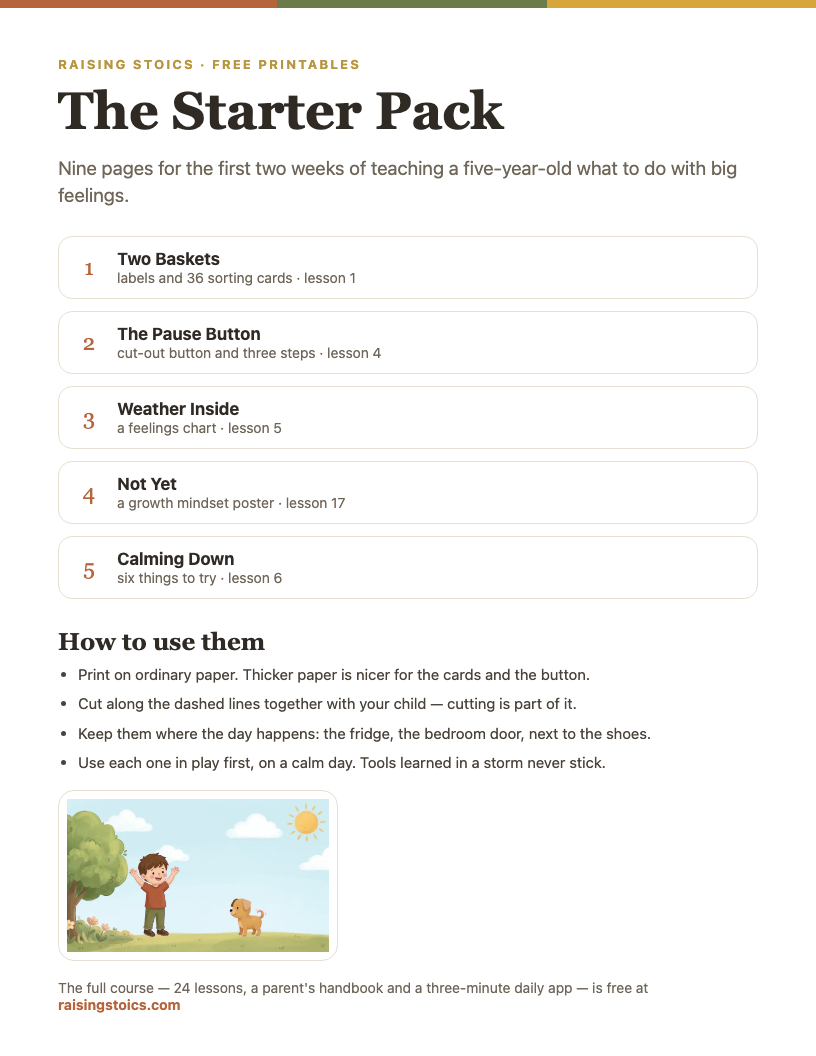
The Big Feelings Starter Pack
Nine pages for the first two weeks: a sorting game, a pause button, a feelings chart and a calm-down poster.
Download the free PDF See all 9 pages
Part of a free 9-page starter pack. Sign in with a code from your email — no password.
What is the "imagine it's gone" exercise?
An old Stoic practice, cut down to a 5-year-old's size.
The Stoics deliberately imagined losing what they had, so they could see it properly again. People stop noticing what's always there, and children seem to do it even faster than adults. Taking something away in imagination for a minute makes it visible again.
The child's version is a silly game. Pick something ordinary, like spoons, shoes, or the faucet, and imagine a whole day without it. How do we eat soup? Show me. How do we get to the park with no shoes? The laughing is the point. Then: "Good thing there are spoons."
Two rules keep it gentle. Only things, never people or pets. And never use it as a warning about what could be taken away.
Can a gratitude journal for kids work if they can't write yet?
Yes, as long as it's a drawing journal.
A written gratitude journal is an adult format. For a 4- or 5-year-old, writing is slow enough to swallow the whole exercise, and what's left is handwriting practice with a nice cover. Drawing is how they think on paper anyway.
Keep it very simple: a plain notebook, one small drawing a day of one good thing. You can write a few words underneath from their dictation if they want, and add the date. Don't correct the drawing or ask them to add more.
Skip days freely. A journal that turns into homework stops being about noticing. Every few weeks, flip back through it together. Children love seeing their own record, and "remember the day with the big puddle?" is gratitude too.
Gratitude activities for kids at dinner, at bedtime, and in the car
The easiest gratitude habits piggyback on moments you already share.
At dinner: "Who did something good for you today?" One person each, with what they did. Asking "who" instead of "what are you grateful for" gives a young child something concrete to find, and it points gratitude at people rather than things.
At bedtime: the best-part game. Each of you names the best part of the day and one small thing that went right that nobody noticed — the bus came on time, the rain stopped for the walk home.
In the car: "I spy something we'd miss if it were gone." A playful version of the Stoic exercise of imagining something is gone: the park, the bakery, the neighbor's dog. It sounds odd, but it makes ordinary things visible.
On weekends: a thank-you drawing. Once a week, your child draws something for a person who helped them — a teacher, a grandparent, the librarian — and you deliver it together. Seeing the person's reaction often teaches more about gratitude than a conversation would.
Keep each one to a minute or two. Gratitude at this age grows through small repetitions, not long reflections. Around the holidays, the secret-giving tradition in is Santa real is another way in.
Why do kids seem so ungrateful?
Mostly because the thinking gratitude requires is still developing, not because they're spoiled.
Full gratitude means understanding three things at once: that something good happened, that someone chose to do it for you, and that it cost them something — time, money, or effort. Young children often see the first and miss the second and third. A present is simply a present; the person who wrapped it barely registers.
They also live in the present. The disappointment that the ice cream is gone is real right now, and last week's treat is out of sight. Adults can hold both; 5-year-olds often can't yet.
And they see only a small part of what adults do for them. The meals, the laundry, and the planning behind a birthday party are invisible to a child.
So instead of "you should be grateful," help them see the missing pieces: "Grandma spent all morning making this. She was thinking of you." Point at the effort, name the person, and let the gratitude grow from understanding rather than from guilt.
What do I say when my child complains about what they have?
Hear the complaint first. It's usually a real feeling, even if it's out of proportion.
The tempting reply is "some children have nothing." It rarely helps. It makes a child feel guilty, and guilt doesn't turn into gratitude. It also teaches them that gratitude is something grown-ups use to end an argument, which makes the jar and the journal feel like enemies.
Try the plain response: "You really wanted the other one. That's disappointing." Then leave it. Later, at a neutral moment, play the imagine-it's-gone game about something unrelated.
This is one reason to keep the exercises light. Gratitude that shows up only when a child is being scolded gets tangled up with being scolded.
Should I make my child say thank you for gifts they don't like?
Ask for the thank-you. Don't ask them to fake the feeling.
There's an honest way through this for a 5-year-old: thank the person for what they did, not for the object. "Thank you for thinking of me" or "thank you for coming" is true even when the sweater is itchy. It also happens to be a small first version of real gratitude, because it's about the giver.
What backfires is insisting they love it. A child required to be grateful for something they genuinely don't like learns that gratitude is an act you put on for adults. That lesson works directly against everything else on this page.
Practice the sentence at home before a birthday party. Knowing what to say ahead of time takes most of the awkwardness out of it.
How do I model gratitude as a parent?
By saying the small thank-yous out loud, especially the ones nobody asked for.
Children pick up gratitude mostly from what they hear adults notice. "Thank you for helping me carry that." "I'm so glad the neighbor watered our plants." "Wasn't it kind of the bus driver to wait?" These little comments show a child what it looks like to notice other people's efforts.
Thank your child too, for specific things: "Thanks for putting your cup in the sink." Children who are thanked learn how it feels, and they may be more likely to do it themselves.
Notice the ordinary good things in your own day, briefly and without preaching: "I love this patch of sunshine." "This soup is warming me up."
And be careful with complaining in front of them. A family where every meal is criticized and every gift compared teaches its own lesson. You don't have to pretend everything is wonderful, but a balance of noticing the good matters.
Writing a thank-you note together after a birthday, even one they only sign or draw on, is a good ritual — as long as it's done with them, not as a chore imposed on them.
How will I know it's working?
They start noticing things without being asked.
The first sign is usually small and a bit random: "the bath is really warm tonight," or stopping to look at a dog. The second is that they name a person rather than a thing: "Grandpa made the pancakes." That shift from what to who is the one to watch for, because it's the start of the fuller kind of gratitude.
Another good sign is when they start the imagine-it's-gone game themselves at breakfast, about the toaster.
Don't expect any of this right away, and don't measure it by thank-yous. If a child has found the game upsetting rather than funny, drop the imagine-it's-gone game and stay with the jar. Some children find imagining things gone too vivid, and that's worth knowing about your child.
FAQ
What is gratitude for kids?
For kids, gratitude means noticing something good in their life and the people who made it happen — like realizing a friend shared their snack, or that Grandpa came to watch their show. It's more than saying thank you; it's seeing the good and the person behind it. At ages 4–7, it grows through small, regular habits of noticing.
How do I raise grateful kids?
Make noticing a daily habit, not a lecture. Ask who did something good for them today, say your own thank-yous out loud, help them see the effort behind things they receive, and let them give to others in concrete ways, like making a card. Avoid forcing thank-yous as a performance. Gratitude grows from understanding and example more than from rules.
At what age do kids understand gratitude?
Young children can say thank you and notice good things from about three or four, especially with prompting. Understanding that someone chose to do something for them, at some cost, develops gradually and, according to research on children's gratitude, tends to become clearer between about seven and ten. So at five, gratitude is mostly noticing with a person attached, and that's a real and useful start.
Are thank-you notes worth it for young kids?
Yes, if they're simple and done together. A young child can draw a picture, sign their name, or tell you what to write. Talking about the person while making it — "Aunt Jo chose this because she knows you love dinosaurs" — is where the learning happens. A long note written as a chore mostly teaches that gratitude is homework.
How to Teach Kids Kindness: Noticing Comes Before Niceness
How to teach kids kindness at ages 4–7: why it starts with noticing, what to do instead of a forced apology, and kindness activities a 5-year-old can really do.
Read next →Enough and Imagine It's Gone are lessons 14 and 21 of the program.