 Raising
How to Teach Kids Patience: Waiting Is a Skill, Not a Virtue
If you're wondering how to teach kids patience, start by dropping the idea that it's a character trait — that's why lectures about it go nowhere. For a young child, a wait is a practical problem with three parts: what to do with my head, what to do with my body, and how I'll know it's over.

Why is patience so hard at 4, 5, and 6?
Because the part of the brain that holds a goal in mind while ignoring a temptation is one of the last to mature, and at five it's still very much under construction.
Psychologists call the cluster of skills involved executive function: keeping a rule in your head, stopping an action halfway, switching attention on purpose. All three improve steeply between about three and seven, and research on training programs suggests practice helps, not age alone. A 4-year-old who can't wait usually isn't being defiant. They're working with equipment that is half-built.
Two things make it harder still. Young children seem to experience waits as longer than adults do, and they have little sense of clock time yet. And the pull of a reward is strongest when it's close and visible. That's why the same child can wait calmly for a birthday that's weeks away and fall apart over a cookie on the counter.
The good news is in the same research: these skills appear trainable, and in one major review (Diamond & Lee, 2011) the children who started furthest behind gained the most.
Why doesn't telling my child to be patient work?
Because "be patient" describes how the wait should look from the outside, not how to get through it from the inside.
An adult who waits well in a line isn't summoning a virtue. They're checking their phone, planning dinner, and glancing at the front to see how many people are left. Every one of those is a technique, and none of them is obvious to a 5-year-old.
So when a child can't wait, the useful question isn't "why are they so impatient?" It's "which part of this wait do they have no plan for?" Usually it's all three.
What are the parts of waiting I can actually teach?
Three, and each one fixes a different kind of meltdown.
A plan for the head. Something to think about or do that isn't the thing they want. Singing, counting, a game of I Spy, looking away from the treat. Waiting goes badly mostly when attention is locked on the object.
Something for the body. Hands that have a job fidget less. A small car in the pocket, a string to twist, squeezing your hand in a pattern.
A visible end. A wait with no shape feels endless, and "soon" has no shape. "After this song" or "when the sand runs out" does.
When a wait falls apart, check which of the three was missing. It's rarely willpower.
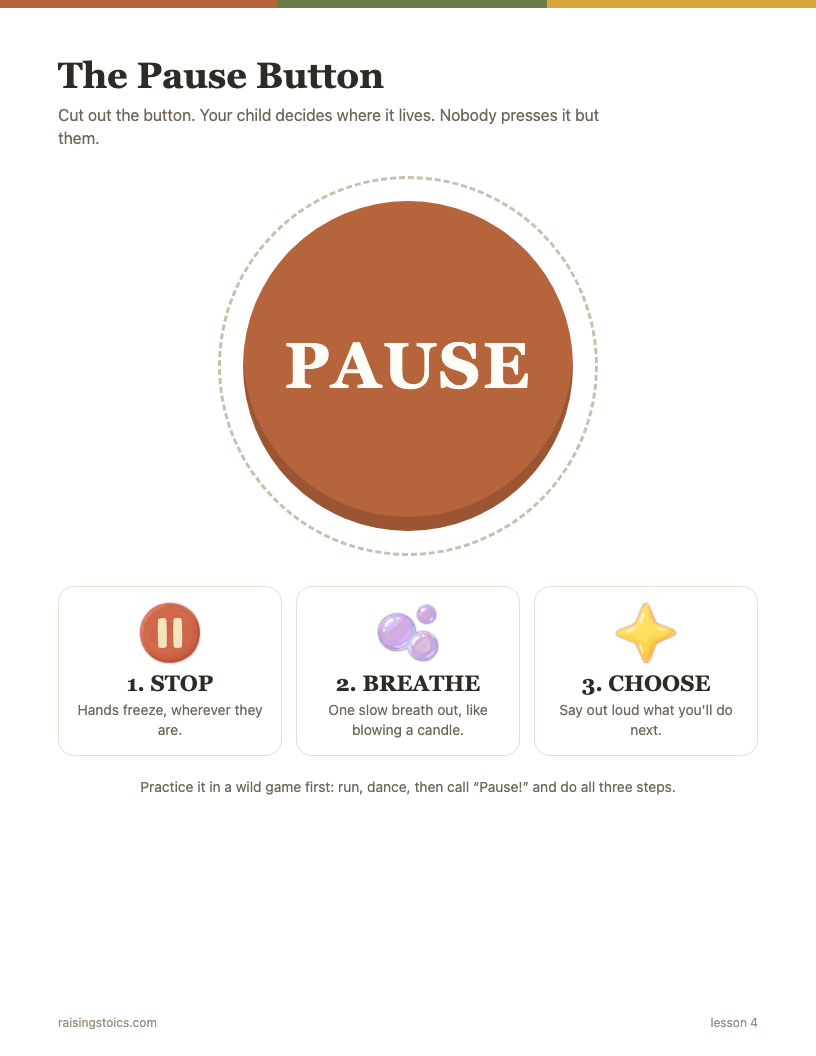
The Pause Button
A cut-out button: stop, one long breath out, then choose. Practice it in a wild game first.
Download the free PDF See all 9 pages
Part of a free 9-page starter pack. Sign in with a code from your email — no password.
How to teach kids patience, step by step
Think of it as a four-week plan rather than a lesson, because the skill grows from repetition, not from being explained.
Week one: make waits visible. Buy or borrow a sand timer and use it for everything small — the last minute before the park, the wait for a turn on the tablet, the time until pancakes are ready. Say out loud what the timer is for. Don't ask for any patience yet; just let the wait have a shape.
Week two: add a plan for the head. Before a wait starts, choose one trick together: a song, counting cars, a game of I spy, turning your back on the thing. Praise the trick, not the waiting: "You sang the whole time. That's how you got through it."
Week three: add a job for the hands. A small toy in the pocket for waiting in line, a string to twist, squeezing a hand in a pattern. Keep the tricks the same every time, so they become automatic.
Week four: stretch slightly. If three minutes goes well, try four. If a wait falls apart, go back to the last length that worked, without comment. You're looking for a child who reaches for a trick without being reminded — that, not the length of the wait, is the sign it's working.
What do I do when the wait falls apart anyway?
Treat it as a wave, not a verdict. Meltdowns over waiting usually peak and pass on their own if nothing feeds them.
In the moment, say less. Name what's happening in one short line — "Waiting is really hard right now" — and stay close. Don't renegotiate the wait while they're crying, because a child who learns that the meltdown shortens the wait will, quite reasonably, melt down more. Don't lecture about patience either; nothing you say about virtues can be heard at the peak.
When it's over, keep it short and practical. "That one was too long. Next time we'll bring the car for your pocket." You've told them the problem was the plan, not them — which is both kinder and more accurate.
If the wait genuinely was too long for today — they were tired, hungry, or it had been a hard morning — it's fine to shorten the next one. That isn't giving in. Giving in is ending the wait because of the screaming; adjusting is ending it because you misjudged the load.
How do I make the end of a wait visible?
Translate time into something they can see or count, because minutes mean very little at five.
A sand timer is the classic for a reason: the wait is sitting on the table, visibly getting smaller. For longer waits, use events they already know — "after bath," "after two more stops," "when the big hand is on the six." For days, a paper chain with one link torn off each morning turns "how many more days?" into something they can answer themselves.
The other half is keeping your word. "Later" only works as a promise if later actually comes. A child who has learned that later means never will, quite rationally, stop waiting for it.
How long can a 5-year-old be expected to wait?
Less than the adult world tends to ask of them, and it varies a lot with the day.
A wait that's fine after breakfast can be impossible at five in the afternoon, when they're tired and hungry. How much they want the thing matters, and so does whether they can see it. A cookie on the counter is a much harder wait than a cookie in the cabinet.
The practical approach is to find the wait they can manage, succeed at it a few times, and then stretch it slightly. If they can't wait at all, start at thirty seconds. That's not babying; it's where the training starts.
What are good patience activities for kids?
Anything where the waiting is built into the activity, so nobody has to impose it.
Planting a bean and checking it every morning. You can't hurry it, and pulling on it to help just brings it out of the soil — which is worth trying once, together.
Baking, where the oven sets the timer and nobody can argue with it. Board games with turns. Building a puzzle over several days rather than one sitting. Saving up coins in a clear jar for something small they've chosen, so the progress is visible.
How Does My Fruit Grow? by Gerda Muller is lovely alongside a planting project: a year of a garden in which nothing arrives on demand.
How do I stop my child from interrupting?
Give them a way to get in line that isn't talking.
A widely used trick: when they need you while you're speaking to someone, they put a hand on your arm. You put your hand on theirs to say "I know you're there," and you turn to them at the next pause. The hand is the plan for the body, and your hand on theirs is the visible promise that the wait will end.
It only works if you do actually turn to them soon, especially at first. Keep the early waits very short. And practice it when nothing is at stake — a pretend phone call is fine — before relying on it with a real one.
Should I make my child wait on purpose, to build patience?
Not artificially. There are enough real waits in a child's day to practice on, and manufactured ones can end up teaching that adults are arbitrary.
What helps more is making the ordinary waits predictable. A set time for the treat. A set order for turns. The screen comes after dinner, every day, not whenever the argument wears you down. Predictability often removes a surprising share of the fight, because a child who knows when a thing is coming has less reason to keep checking.
And be honest about reliability. Children tend to wait longer for adults they've learned to trust. If "in five minutes" regularly means twenty, they are right to push.
How do I know it's working?
Look for the trick, not the endurance.
The early signs are small and a bit funny: they turn their back on the cake without being asked. They start humming in the checkout line. They ask for the timer themselves. They say "I'll wait and have two" when they could have had one now.
When you notice it, name the method rather than the virtue. "Good idea, turning around" is something they can repeat. "You're so patient" is a label they can lose the next time they aren't.
Expect bad days to keep happening. A tired child with no plan will still fall apart at the pharmacy, and that says nothing about next week.
FAQ
How do I have more patience with my kids?
Mostly by fixing the conditions, not by trying harder. Parents run out of patience for the same reasons children do: tiredness, hunger, too many demands at once, and no plan for the hard moment. Pick your two worst flashpoints of the day and plan them in advance — what you'll say, where you'll stand. And use a trick you'd teach your child: one slow breath out before you answer. It's small, and it's enough to change what comes next.
How do you teach patience to a 4-year-old?
The same way as a 5-year-old, with shorter waits and more props. At four, start at thirty seconds to a minute, always with a visible end — a sand timer or "when the song finishes." Give the hands a job and do the waiting trick together rather than asking them to do it alone. Four-year-olds often borrow calm from the adult next to them, so your voice and pace may matter more than any instruction.
Is impatience normal at 5?
Yes. Most 5-year-olds find waiting hard, interrupt often, and struggle most when the thing they want is in sight. What matters is the direction: over months, a child should manage slightly longer waits and start using tricks on their own. If impatience comes with constant impulsivity, trouble at preschool, and no improvement at all over a year, it's worth mentioning to your pediatrician.
What games teach kids to wait?
Games where stopping and starting is the whole point. Freeze dance, Red Light, Green Light, and Simon Says all train holding back an action until a signal comes. Board games teach waiting for a turn, and cooperative ones (where everyone wins or loses together) keep the waiting from turning into a fight. A few minutes a day of any of them is practice for the real waits, with the stakes removed.
How do I explain patience to a child?
Describe it as a skill with tricks, not as being good. "Patience means waiting without getting stuck on the wanting. People do it with tricks — singing, counting, looking away." Then ask them to invent a trick of their own and try it on the next small wait. Children understand patience far better once they have a trick with their name on it.
Self-Control Activities for Kids: Games That Build It
Self-control activities for kids 4–7: how self-control develops, which games genuinely train it, and why instructions and reminders don't.
Read next →Being the boss of your own "want" is lesson 13 of the program.