 Raising
How to Teach Kids Responsibility: Ownership, Not Obedience
When parents ask how to teach kids responsibility, most of what they mean is really obedience with a nicer name. At five, the real thing is smaller and sturdier: knowing which parts of a situation are yours, and taking care of those.

What does responsibility actually mean for a 5-year-old?
Owning what's in your basket — the part of what happens that depends on you, and nothing more.
The tower fell: not yours. What you do with the blocks now: yours. Your brother grabbed the crayon: not yours. Whether you hit him: yours. Many 5-year-olds can make that distinction fairly reliably once it has been made physical for them, and it turns responsibility from a vague moral quality into a short, checkable list.
It also cuts in both directions, which is the part adults forget. A child who is taught they're responsible for everything, including other people's moods, is more likely to end up anxious than responsible. The sorting protects them from that as much as it asks something of them.
Isn't a responsible child just one who does what they're told?
No, and the difference shows up the moment you leave the room.
Obedience is a relationship between a child and an adult: you ask, they comply, and the reason for doing it lives in you. Responsibility is a relationship between a child and a task: the reason lives in the task. The socks go in the hamper because that's where socks go, not because someone is watching.
You can get obedience quickly with pressure, and it has its uses — near roads, for instance. But it doesn't grow into responsibility on its own. It tends to grow into a child who does the right thing when observed and very little when not, which is the opposite of what anyone wanted.
How to teach kids responsibility, one job at a time
Start with one job that is clearly theirs, and let them own all of it — including the part where it goes wrong.
Pick something with a visible result and a natural rhythm: feeding the goldfish, watering one plant, putting their shoes on the rack, setting out spoons for dinner. One job, not five.
Show it once, slowly, together. Then do it together for a few days. Then step back and let them do it while you're nearby. The handover is gradual on purpose; a job dumped on a child all at once feels like a test they can fail.
Make it visible. A picture of the fish on the fridge, with a checkbox for each day, lets them see their own reliability grow. Pictures are easier than words for a child who isn't reading yet.
Let the natural result do the teaching where it's safe. If the plant droops because it wasn't watered, look at it together — "What does it need?" — rather than delivering a speech. The plant is a better teacher than you are.
Add a second job only once the first one runs by itself without reminders.
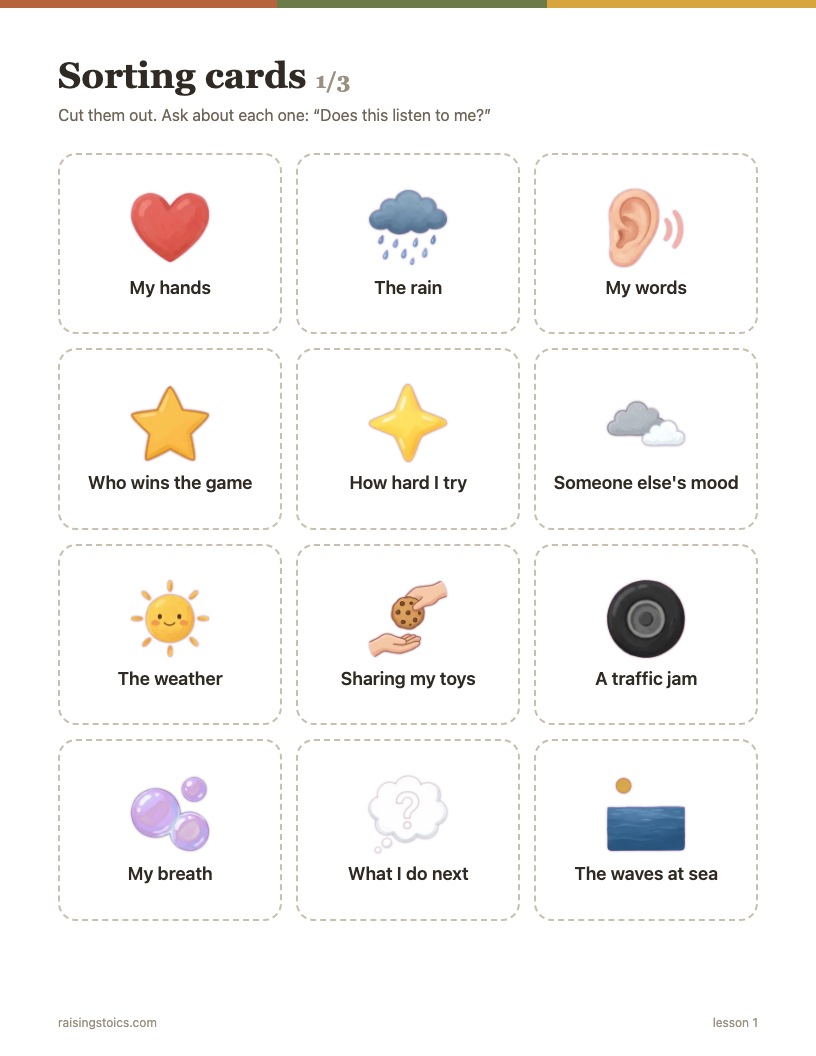
Two Baskets sorting cards
36 picture cards: what listens to me, and what doesn't. The first lesson of the program, played as a game.
Download the free PDF See all 9 pages
Part of a free 9-page starter pack. Sign in with a code from your email — no password.
What chores can a 5-year-old or 6-year-old actually do?
More than most get asked to, as long as each job is small, visible, and the same every day.
A realistic list for five: put dirty clothes in the hamper, carry their own plate to the counter, set out spoons and napkins, feed a pet with the scoop measured for them, match socks, water one plant, put shoes where shoes go, wipe up their own spills.
By six, many children can add: make their bed, more or less, sort laundry into lights and darks, unload the spoons and forks from the dishwasher, pack their own bag with a picture checklist, put groceries away in low cabinets.
Two or three regular jobs is plenty. A job they own completely beats five they do with you standing over them.
What does responsibility look like at 4, 5, 6, and 7?
It grows in small, visible steps, and expecting the right step for the age avoids a lot of frustration.
At four: one or two simple jobs with an adult nearby — putting shoes on the rack, carrying their plate to the counter, putting toys in a box. Reminders are normal and expected.
At five: a few jobs they can do alone once shown, like feeding a pet, setting spoons on the table, getting dressed with clothes laid out. They can start owning small mistakes — "I spilled it, I'll get a towel" — with help.
At six: a short morning routine with a picture checklist, packing their own bag with support, picking up their room to a simple standard. They can start remembering a job without a reminder on some days.
At seven: a regular weekly job, keeping track of their own belongings at school, and apologizing and repairing after a mistake with less prompting.
These are rough guides, not tests. What matters is the direction: fewer reminders, more ownership, month by month. A child who is steadily moving along this path is doing well, wherever they started.
How do I get them to do chores without a fight every time?
Make the job theirs rather than a favor to you.
That means one job, done at the same point every day, with a name: they're the plant person, or the one who does spoons. Children of this age often take titles seriously. It also means the job stays done their way. If you redo the napkins after they've set them, you have told them the napkins were never really theirs.
Anchor it to something that already happens — after breakfast, before bath — so it becomes part of the routine rather than a fresh negotiation each time. And do your own jobs visibly at the same moment. "I'm doing mine, you're doing yours" lands far better than "go do yours."
Should I pay for chores or use a sticker chart?
For the everyday jobs that come with living in a family, it's usually better not to.
The trouble with paying for the plate-to-the-counter kind of job is what it teaches about why you do it. The reason moves from the task to the reward, and once it's moved, the obvious next question is "what do I get?" — including for things that were happening fine before.
If you want an allowance in the picture, keep it separate from ordinary household jobs, or reserve it for genuinely extra work. And if a chart helps as a reminder of what comes next, a picture checklist does that without any stickers at all. The point of the chart is memory, not payment.
What do I do when they forget or do it badly?
Expect both, and treat them as the ordinary texture of learning rather than evidence of character.
Forgetting at five is often a memory problem, not a character problem. Holding "after breakfast I feed the cat" in mind across a morning is genuinely hard, so give the memory somewhere to live — a picture by the bowl, the same cue every day — instead of a lecture about remembering.
Doing it badly is a skill problem, and skill comes from repetition, not correction. Show it once more, side by side, and then leave it. A lumpy bed made by a 6-year-old is a made bed. Standards can rise later; ownership, once lost, is hard to get back.
How do I teach them to own a mistake instead of blaming someone else?
Make owning it cheap. "It wasn't me" is often a prediction about what happens next.
If admitting a spill brings a paper towel and a shrug, children admit spills. If it brings a raised voice and a speech, they learn that the smart move is to point at the dog. The honesty you get tends to track how safe you've made it.
The baskets help here too. "The juice falling wasn't really in your basket — cups tip. Wiping it up is." That separates the accident, which no one needs to feel bad about, from the response, which is theirs. And own your own out loud: "I forgot to buy milk. That one's mine. I'll go tomorrow morning."
Why is my child responsible at school but not at home?
Because school is built for it and home usually isn't.
A classroom has a fixed routine, a place for everything, the same expectations every day, and a room full of other children doing the same job at the same time. A child hangs up their coat at preschool because the hook is right there, everyone else is doing it, and it happens at the same moment every morning.
Home is looser: routines shift, things live in different places, and a parent will often step in and do it faster. None of that is a failure; it's just a different setup.
Borrow what school does. Give each job a fixed place and a fixed moment — shoes on the rack as soon as you walk in the door, cup in the sink right after breakfast. Use a picture checklist for the morning. And resist doing it for them when you're in a hurry; that's the moment they learn whether the job is really theirs.
How do I know it's taking hold?
Watch for the small moments when nobody asked.
The plate carried to the counter without a reminder. "That's my job" said with a trace of possessiveness when a sibling tries to do it. A spill reported rather than hidden. A question like "is that in my basket?" arriving on its own, about something that actually matters to them.
The strongest sign tends to come later, when they make rules for themselves and keep them. A rule a child wrote in their own words is defended in a way that a rule handed to them never is. That's the adult version of responsibility in miniature: not doing what you're told, but keeping what you chose.
FAQ
What is responsibility for kids?
Responsibility for kids means knowing which things are yours to look after — your shoes, your toys, your words, your part of a job — and looking after them without being reminded every time. For a 5-year-old that might be feeding a pet, putting their plate in the sink, or owning up when they break something. It grows from small jobs they fully own, not from being told to be responsible.
How do I teach my child financial responsibility at 5 or 6?
Start with seeing and choosing. Give a small allowance in coins and use three clear jars: spend, save, give. Let them choose what to buy, including things you think are a waste, and let them feel the result when the money is gone. Saving up for something they picked themselves teaches more about money than most explanations.
At what age can a child be responsible for their own things?
From about four, many children can take care of a few of their own things with a fixed place and a routine — shoes, a backpack, a special toy. By six or seven many can manage more, like packing their bag with a picture checklist. What varies is the support they need, not whether they can do it: a hook at the right height does half the work.
How do I teach responsibility without nagging?
Replace reminders with structure. A picture checklist, a fixed place for each thing, and a fixed moment in the day do the reminding for you. When something is forgotten, ask a question instead of repeating the rule: "What's next on your list?" And let small natural consequences happen — a forgotten library book means no new one this week — so the job stops belonging to you.
Chore Chart for Kids Ages 4–7: Jobs by Age and a Free Printable
A chore chart for kids that actually gets used: which chores fit ages 4–7, how to set it up, rewards and allowance, and a free printable weekly chart.
Read next →Two Baskets is the first lesson of the program, and it's open in full. The rules they write themselves come in lesson 23, My Fort.