 Raising
5-Year-Old Tantrums: Temper Tantrums at 4–6 and What Helps
5-year-old tantrums are common, and they aren't just larger toddler tantrums. In 2025 US survey data, about 9 in 10 parents of 5-year-olds said their child loses their temper at least sometimes, while only about 6% said it happens most of the time or always. The child now has words, memory, and a strong sense of how things are supposed to go, and that changes what the tantrum is about and what helps.


What would you do? Try this as a two-minute scene: pick what you'd do and see what tends to happen next.
Why is my 5-year-old still having tantrums?
Because the skills that replace tantrums are still under construction, and will be for a while.
Between four and six, children want more, understand more, and remember more about how things ought to go, but their ability to manage the gap when things go differently lags well behind. Tantrums tend to become less frequent across this period, but they don't disappear on a schedule, and a 5-year-old having one after a long, overstimulating day is well within the ordinary range.
What tends to change isn't whether they happen but what they're about, how long they last and how quickly the child recovers. Those are the things worth watching.
How common are temper tantrums in 5-year-olds?
Very common, at least occasionally. The 2025 National Survey of Children's Health asked parents how often their child loses their temper. For 5-year-olds, about 3% of parents said always, 3% most of the time, 10% about half the time, 72% sometimes, and 12% never.
So nearly 9 in 10 five-year-olds lose their temper at least sometimes, and the share who do it most of the time or always is about 6%, about the same as at ages 3 and 4. We calculated these numbers ourselves from the survey's public data; see our data on emotional regulation skills at 3, 4, and 5.
What this means in practice: an occasional meltdown at five is ordinary. Tantrums most days, especially intense ones, are less common, and worth a closer look and a conversation with your pediatrician.
How are tantrums at 4 to 6 different from toddler tantrums?
A toddler tantrum is mostly about being overwhelmed with no words to spare. By four to six, a few new things are mixed in.
The triggers become more about fairness, control, and disappointment: a sibling got more, the plan changed, the game ended before they'd won. There's often an element of argument, since the child now has language and uses it — sometimes loudly.
Many children can hold it together at school and fall apart at home, which is confusing but common: they've spent their self-control all day and let go where it's safe.
And occasionally some part of a tantrum is aimed at getting something. That's rarely the whole story, but it does mean what you do afterward matters more than it did at two.
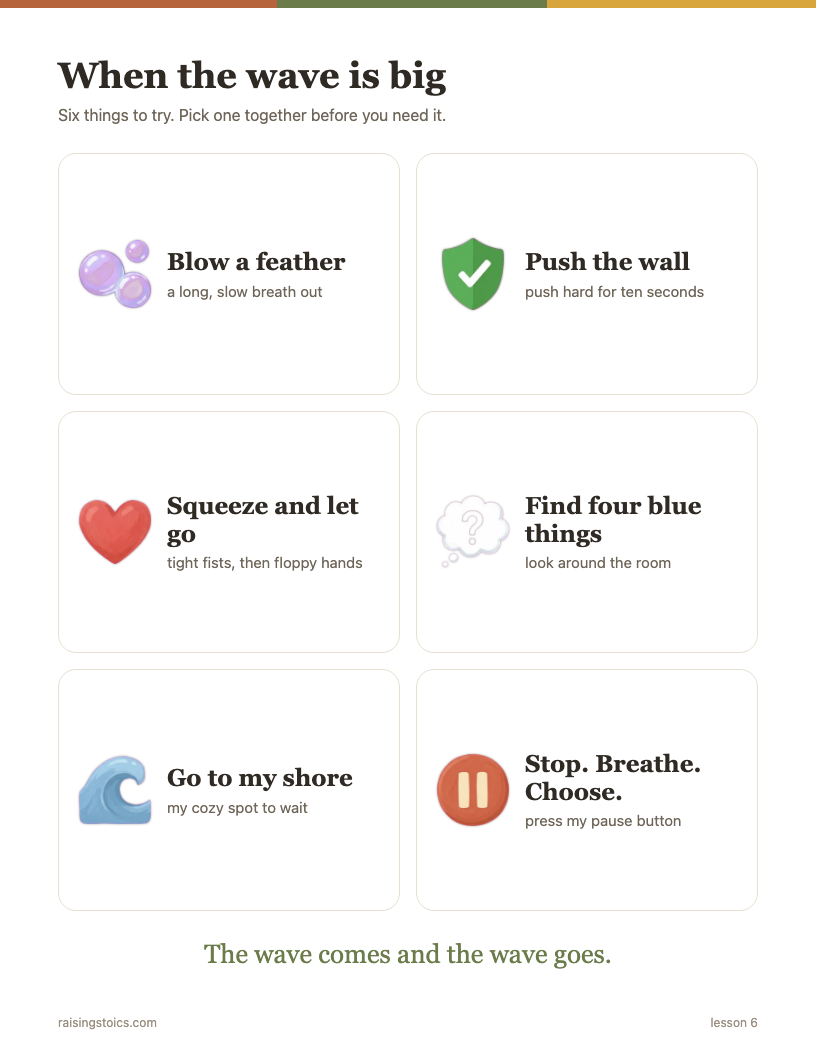
Six ways to calm down
A fridge poster: blow a feather, push the wall, find four blue things.
Download the free PDF See all 9 pages
Part of a free 9-page starter pack. Sign in with a code from your email — no password.
Why do tantrums sometimes get worse around 4, or just before?
Plenty of parents notice a bump somewhere around three and a half to four, and it's often a sign of development, not a step backward.
At that age, a child's will, imagination and opinions are growing fast. They have much clearer ideas about how things should go and much stronger feelings when they don't. Language is racing ahead too, so there's more to argue about. Regulation doesn't grow at the same speed, so for a while the gap between wanting and managing may actually widen.
Other things commonly add to it: dropping the nap, starting preschool, a new sibling, a move. If an almost-4-year-old's tantrums have picked up, check the ordinary things first — sleep, food, transitions, and changes at home — before assuming anything more.
What is the wave shape, and why does it matter?
Most tantrums follow the same curve: they build, peak, and then come down on their own. Many are over within a few minutes, though some run longer.
The shape matters for two reasons. For you, it's reassuring: a tantrum isn't an emergency to be solved, it's a wave to be waited out. Knowing there's a downslope coming makes it much easier to stay steady on the way up.
For your child, it's even more important. At five, a big feeling seems permanent from the inside, which is part of what makes it so frightening. A child who has had the shape pointed out to them afterward — several times, calmly — starts expecting the downslope. Expecting it can make the wave easier to ride out.
5-year-old tantrums: the most common triggers
Most tantrums at four to six come from a short list of situations, and knowing yours is half the work.
Transitions. Leaving the park, turning off a show, stopping a game for dinner. Being pulled from something absorbing without warning is one of the most common triggers at this age.
Tiredness and hunger. The late afternoon, the hour before dinner, the car ride home. A child who could handle a disappointment at ten in the morning may not handle the same one at five in the evening.
Things not going to plan. Five-year-olds carry a strong picture of how something should go — the blue cup, the usual route, the right way to cut the sandwich — and a change to the plan can feel like a real loss.
Losing. Board games, races, being last in line. Winning and losing matter enormously at this age, and the skill of losing gracefully is still developing.
Unfairness. "He got more!" A strong sense of fairness is often in place by now, well before the ability to cope when things aren't fair.
After school. Many children hold it together all day and let go at pickup.
For a week, jot down when tantrums happen. The pattern usually jumps out, and it tells you where to put the warnings and snacks.
What can I do before a tantrum starts?
Most of the useful work happens hours or days earlier, not in the moment.
Look for the pattern. Tantrums at this age cluster: late afternoon, after school, before meals, at transitions, after big exciting days. Once you know the danger windows, you can put a snack, a quiet half hour or an early warning in front of them.
Play the wave when nothing is wrong. Under a blanket, your child rises, gets louder and bigger, peaks, and comes back down — slowly, several times. It sounds silly and it is, which is part of why it helps: the body learns that big things come down.
And let them choose a shore — a spot to wait while the wave is big. Picked by them, not assigned by you.
What should I do during the tantrum?
Stay close, say very little, and don't change the answer that started it.
During the peak, explanations don't land, so save them. One short sentence is enough: "I'm here. The wave's big right now." Keep everyone safe, and move away from an audience if you can.
The harder part is holding the original decision. If the tantrum began because the answer was no, the answer stays no — kindly, without further debate. A child who learns that a big enough wave changes the outcome will often produce bigger waves. That's not manipulation in any sinister sense; it's a 5-year-old noticing what works.
You can be completely warm about the feeling and completely unmoved on the decision at the same time. That combination is the whole job.
How do I handle a tantrum in public?
Much the same as at home, with one extra step: stop caring about the audience, because your child can tell when you do.
Move somewhere quieter if you can — a corner of the store, outside the door, the car. Fewer people and less noise make it easier for the wave to pass. If you can't move, crouch down so you're at their level and turn your back to the aisle.
Keep your words to a minimum. "You're really upset. I'm here." Don't negotiate or bribe to make it stop faster; a tantrum that ends with a treat in public is likely to reappear in public.
If someone comments, a short, calm answer is enough: "She's having a hard time. We're okay." Many of the people who stare are parents who have been there.
If you have to give up on the shopping trip, give up on it. That's not a punishment; sometimes a child simply can't manage the rest of the trip.
And plan ahead for the known hard places. A snack before the grocery store, a job during it ("you're in charge of finding the bananas"), and a warning before you leave the toy aisle prevent more public tantrums than anything done during one.
Tantrum or meltdown: is there a difference?
Parents and professionals often use the words to mean slightly different things, and the distinction can be useful.
A tantrum usually has a goal. The child wants something — the toy, another episode, to stay at the park — and the tantrum is the loudest way of saying so. It often eases when the child sees it isn't changing the outcome, and some children check whether anyone is watching.
A meltdown is more like a system overload. The child is overwhelmed — by noise, tiredness, too much happening at once — and has lost the ability to cope. They're not trying to get anything; they're past the point of being reachable. Meltdowns generally don't respond to limits or consequences, and they end when the child settles.
In real life, one can turn into the other: a tantrum about leaving the party can tip into a meltdown if the child is also exhausted.
The response overlaps — safety, few words, a calm adult nearby — but the emphasis differs. For tantrums, hold the limit kindly. For meltdowns, reduce the input: quieter, dimmer, less talking. Frequent meltdowns, especially with sensory triggers, are worth mentioning to your pediatrician.
What should I do after the tantrum is over?
Wait longer than feels natural, then look back at it together — briefly and without blame.
Not the moment the crying stops; later, when they're genuinely settled, perhaps at bedtime. Trace the shape: "Remember this afternoon? When was it biggest? And when did it stop? What were you doing after?" Many children are surprised to hear that it ended, which is exactly the thing you want them to notice.
If something needs repairing — a thrown toy, a hurt sibling — do it then, together, and keep it short. Skip the lecture about what they should have done; it will mostly be heard as blame.
Mark the ending with a phrase you both use: "The wave came and the wave went." Over time, that sentence becomes something they can say to themselves.
5-year-old temper tantrums getting worse: when should I worry?
A rough patch is common and usually passes. What deserves attention is a clear trend over weeks or months, not a bad couple of weeks.
First look at what has changed: sleep, a new school, a new baby, a move, stress at home. Those account for a lot of "suddenly worse" and usually settle as the child adjusts.
It's worth talking to your pediatrician if tantrums are getting longer, more frequent, and more intense over several months rather than slowly easing; if they regularly run longer than about fifteen minutes; if your child hurts themselves or others during them; if they happen in every setting, not just at home; or if something else seems off too — sleep, eating, speech, play. That's not a verdict, just a good reason to get another set of eyes.
FAQ
When do tantrums stop?
For most children, tantrums tend to become less frequent between five and seven, as language, self-control, and the ability to wait all improve. They rarely stop completely at once; a tired or overwhelmed 6-year-old can still have one. What you should see is a clear trend: fewer, shorter, and less intense over months. A sudden increase at six or seven is worth looking into.
Should I ignore a tantrum?
Ignore the demand, not the child. Stay nearby and calm, don't give in to what the tantrum is asking for, and don't add lectures or threats. But don't walk away or act as if they're not there, especially at this age; being left alone in a big feeling can be frightening. Keep everyone safe, say little, and reconnect warmly as soon as it's over.
Why does my child only have tantrums with me?
Because you're their safest person. Children often hold it together with teachers, grandparents, and friends' parents, then let everything out with the adult they trust most. It's usually a sign of trust, not of bad parenting. It does help to look at what's different at home — routines, warnings, how limits are held — and borrow what works elsewhere.
Are tantrums at 6 normal?
Occasional ones, yes, especially when tired, hungry, overwhelmed, or facing a big disappointment. By six, most children have fewer and shorter tantrums than at four. Talk to your pediatrician if they're happening daily, lasting more than about fifteen minutes, involving hurting themselves or others, or getting more frequent rather than less.
Calming Strategies for Kids: Calm-Down Tools That Actually Work
Calming strategies for kids ages 4–7: why telling a child to calm down fails, what to do during a meltdown, and the calm-down tools worth rehearsing.
Read next →The Wave is lesson 6 of the program: learning, from experience, that a big feeling always passes.